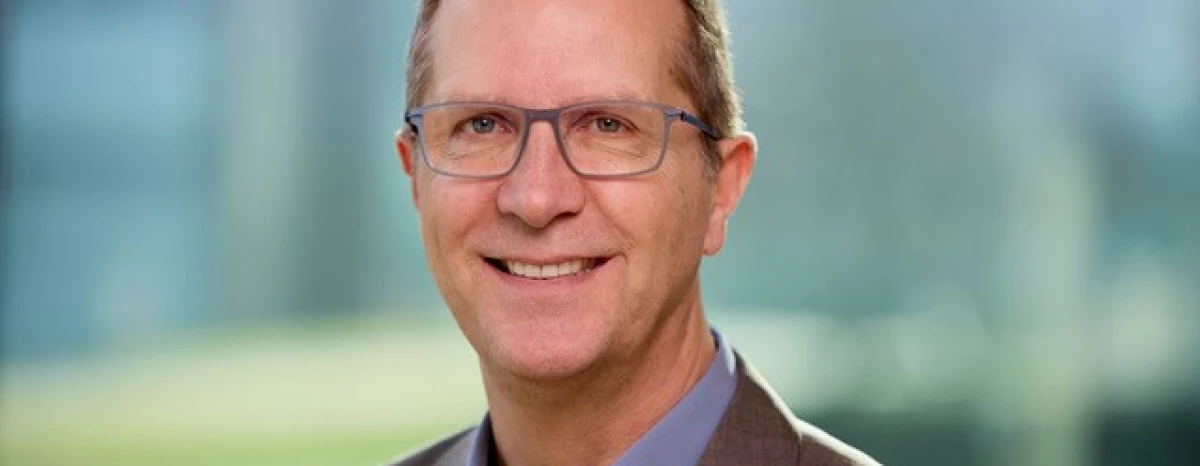
A lot is changing—this applies to sustainability issues as well as to the professional career of our CEO, Daniel Schmid. After 33 years, Daniel has stepped down from active service at SAP and now advises, among others, his beloved club, 1. FC Kaiserslautern, on sustainability issues. In this in-depth econsense interview, Daniel explains how this “change” came about, what he thinks about the current sustainability discourse, and how he views the next 25 years of the network in econsense’s anniversary year.
Whether in the U.S., the EU, or Germany—a lot has happened in recent months. How do you view the current sustainability discourse?
Daniel Schmid: There is hardly any substantive debate taking place on the major political stages. When sustainability was last a topic there, it caused a level of uncertainty that I have never experienced before.
An example: Sustainability is far too often discussed as a regulatory issue. Sure, some regulations are overly detailed. A critical debate is very important here. However, this should not lead to a blanket condemnation of regulation and a desire to abolish it entirely—and sustainability efforts along with it. We must ensure that the pendulum does not swing from one—perceived—extreme to the next.
What we shouldn’t forget amid all this: Away from heated debates, companies are implementing numerous sustainability initiatives and developing strategies. I appreciate this pragmatism. In times of multiple crises, it’s good advice anyway to focus on one’s own sphere of influence.
How can we bring more depth back into the sustainability discourse?
Daniel Schmid: The “why” of sustainability needs to be the focus. We should all play a part in strengthening trust in science. Every conversation can contribute to this. That’s important because, in fact, sustainability is becoming more significant every day.
For us at econsense, as the sustainability network of the German business community, the “why” also means demonstrating the clear business case for sustainability—in a meaningful and pragmatic way. This involves, on the one hand, addressing ecological and social risks. Above all, however, it encompasses the numerous economic opportunities that present themselves to us. Sustainability must be integrated into core business strategy. Only this ensures the company’s medium- and long-term success.
Especially in these volatile times, however, we must also involve people more closely, constantly thinking from the perspective of various stakeholders: What are the issues—and perhaps also the concerns—that drive a particular group? And what arguments might convince them? This can be directed at our own workforce or at future employees, as well as at board members, investors, and customers.
Incidentally, my personal conviction hasn’t changed in all of this: Sustainability is fun and a driver of innovation and motivation. There are numerous positive stories to tell. We must bring these into the discourse in a way that inspires and engages people.
Let’s turn to you: In December 2024, your active career at SAP came to an end after about 33 years, including ten years as Chief Sustainability Officer. How did it come about that you left early?
Daniel Schmid: First of all, we need to note that I never actually applied to SAP. [laughs] My first job after college was at Kiefer & Veittinger, which was acquired by SAP in 1997. That time was counted toward my tenure with the company. Last year, like everyone in my cohort, I received an offer to join SAP’s early retirement program. I’ve always viewed my entire career here as an incredible privilege, and this offer was no exception.
When I think about the steep learning curve I experienced at SAP and all the responsibilities entrusted to me—even at a very young age—I can only be grateful. After all, I had the opportunity to help shape the company’s sustainability journey from day one. Starting at the project level, I soon defined the first company-wide goals and developed the organizational structures.
It was at SAP that I first became involved in sustainability and was entrusted with global responsibility for it as Chief Sustainability Officer from 2014 to 2024. That was a tremendous joy for me. The timing for handing over this responsibility—as well as the wonderful team—to Matthias Medert was perfect for me.
For 33 years, I held roles where my schedule was extremely tight, packed with meetings and obligations. Now I enjoy starting my day a little more leisurely. I can take better care of myself while still focusing on sustainability—for example, at econsense. Since January, I haven’t been bored for a single minute.
In addition to your board role at econsense, you’ve also taken on a completely new role: you’re now a sustainability advisor for your favorite club, 1. FC Kaiserslautern. What does this role entail, and what does it mean to you?
I’ll start with the second part of the question, because it means the world to me. I feel a huge sense of excitement because I can combine two passions—one for sustainability, the other for 1. FC Kaiserslautern. You have to know that I grew up on Betzenberg and lived right near the stadium. At the age of five, I was already active in the FCK track and field program and cheered on the Red Devils at every home game in the stadium.
1. FC Kaiserslautern is a club that, while having great appeal, operates with very lean structures. About 50 people work at the office. For the licensing process through the German Football League (DFL), you have to answer 65 questions on the topic of sustainability. You don’t just check “yes” or “no”—you have to go into great detail about the target and current status. This questionnaire applies to the second-division club FCK, which was still playing in the third division just a few years ago, just as much as it does to the clubs in Germany that have been active in the Bundesliga for a long time.
From the very beginning, the conversations were wonderful. The chemistry was perfect. The club immediately signaled to me that they wanted to make use of my experience and expertise. I serve in an advisory capacity to Stefan Roßkopf, who, as Head of Corporate Communications, is also responsible for sustainability. My role focuses particularly on establishing the organizational framework that fits FCK, refining the strategic approach, and working step by step with the various departments to increase the level of maturity.
FCK has already put some wonderful pieces of the puzzle in place. This is also embedded in the club’s DNA. These are values that Fritz Walter introduced and exemplified, but also a president like Norbert Thines, for whom the social dimension was very much at the forefront. Now the task is to strategically connect these puzzle pieces in a meaningful way. For example, I helped with the materiality analysis; together, we are currently analyzing and improving processes in energy management, waste management, and water management—to name a few topics from the environmental dimension.
But here, too, the key is how we get people on board. This starts with the employees, extends to the members and fans, and reaches all the way to the sponsors. We’re still in the early stages, but I recently held a kickoff event with all employees and had the opportunity to provide some inspiration there. That was a lot of fun, and it was wonderful to see how well it was received, because they see the opportunities to meaningfully move things forward for the club. Things that not only have a positive impact on society and our environment but also help secure the club’s long-term success.
Let’s turn to econsense: You’ve been active here since 2009 and have served as chairman of the board for nearly three years. What does the network mean to you?
I still remember when I started my new role at SAP and checked where we were members. I then asked internally what we do at econsense, and the answer was: We pay membership dues. [laughs] So I thought to myself: If we’re members there, then we’re all in or not at all. Shortly after, I attended my first steering committee meeting and quickly realized the potential econsense offers us.
As a platform for trusting exchange, we don’t just talk about all the great things we’re doing. Here, we speak openly about difficulties and receive support from other companies. I find it very enriching that we’re a cross-industry network offering diverse perspectives.
It has also greatly helped my personal learning curve. Especially in times like these, when resilience is a major issue—both economically and personally—this trusting exchange provides incredible added value. The diversity of perspectives strengthens one’s own stance. You learn to let things go sometimes and to advance your issues with sensitivity and patience.
Last but not least, what sets econsense apart is the immense substantive value that the experts at the office provide to sustainability managers. This makes work life much easier because the topics are so well-prepared and the discussions are so well-organized. I greatly value the collaboration with the econsense team.
That’s why I’ve always looked forward to meetings at econsense and am all the happier to have been serving here as Chair of the Board for the past three years. We also have a very valuable exchange of ideas within the Board team. This includes occasionally debating the issues. I consider it enormously important to hear very different opinions. What matters is that everyone is willing to use these differences to reach a consensus for the future—after all, that’s part of our name.
Speaking of the future: This year, our network turns 25. What do you wish for econsense for the next 25 years?
First of all, we can all be proud of how econsense has developed over the past 25 years. For the future, a good guiding principle is to maintain a certain continuity while continuing to challenge one another to make things even better and generate even more value for our member companies.
This certainly also includes developing an even stronger voice. In recent years, I’ve noticed that numerous organizations and political leaders are reaching out to us and seeking our perspective. This speaks to the reputation econsense has built over the past years. We can continue to expand this voice.
We should never lose sight of the core of our value—the trusting exchange and high-quality content. What’s important to me is that quality matters, not quantity. We are proud to count more than 50 companies among our members. However, our goal is not to reach 100 companies in 25 years. The right companies should be part of this. Companies that contribute their perspectives and knowledge and want to drive things forward. This is how we preserve what defines our network and develop it in a targeted manner.